
Latest Post
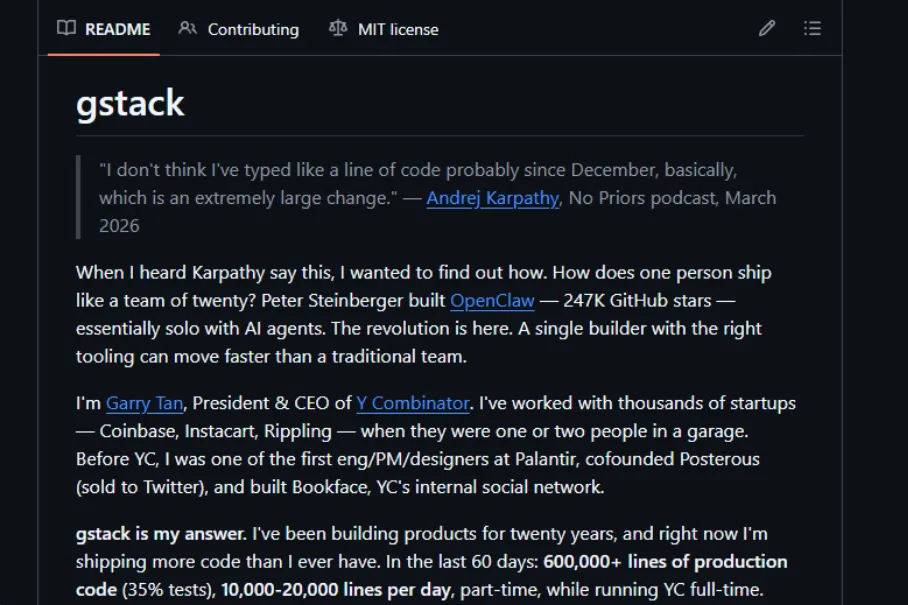
What if you could write over 10,000 lines of production code per day, all by yourself? gstack, released by Y Combinator President Garry Tan, is an open-source tool that transforms Claude Code into a virtual engineering team composed of a CEO, designer, staff engineer, QA lead, security officer, and release engineer. This is backed by a track record of shipping over 600,000 lines of production code in just 60 days. This guide systematically walks you through gstack's installation, all 28 skills, core workflows, and practical tips. What is gstack? gstack is a software factory that runs on top of Claude Code. Rather than a simple coding assistant, it provides 28 specialized skills, each fulfilling a distinct professional role, to systematically manage the entire software development process. Key Metric Details Code Shipped Over 600,000 lines in 60 days (35% test code) Daily Productivity 10,000–20,000 lines/day (part-time work) Number of Skills 28 specialized skills License MIT (completely free, no premium tier) Installation Prerequisites Claude Code – Anthropic's CLI coding tool Git – Version control Bun v1.0+ – JavaScript runtime (for compiled binary generation) Node.js – Required only on Windows Step 1: Global Install (30 seconds) git clone https://github.com/garrytan/gstack.git ~/.claude/skills/gstack cd ~/.claude/skills/gstack && ./setup This installs gstack to ~/.claude/skills/gstack, and Claude Code automatically recognizes all skills. Step 2: Add to Project (Optional) To share the same configuration across your entire team, copy it into your project repository: cp -Rf ~/.claude/skills/gstack .claude/skills/gstack rm -rf .claude/skills/gstack/.git cd .claude/skills/gstack && ./setup Codex/Gemini/Cursor Users # Repo-local install git clone https://github.com/garrytan/gstack.git .agents/skills/gstack cd .agents/skills/gstack && ./setup --host codex # Or global install git clone https://github.com/garrytan/gstack.git ~/gstack cd ~/gstack && ./setup --host codex # Auto-detect ./setup --host auto Core Workflow: Think → Plan → Build → Review → Test → Ship gstack's greatest strength is dividing the entire software development lifecycle into structured stages. Each stage is assigned a specialized professional role. Stage 1: Planning /office-hours – YC Office Hours The starting point for every project. Redefines the product through 6 key questions and generates 2–3 implementation alternatives with effort estimates. /office-hours Two modes are available: Startup mode: Sharp questions about product-market fit Builder mode: Exploratory and generative approach /plan-ceo-review – CEO/Founder Mode Rethinks problems from the user's perspective to uncover the "10-star product hiding inside the request." Supports 4 scope modes: Expansion: Dream big (feature expansion) Selective Expansion: Cherry-pick opportunities Hold Scope: Maximum quality within current scope Reduction: Minimum viable version /plan-eng-review – Engineering Manager Locks in architecture before coding. Visualizes system boundaries, data flow, state transitions, failure modes, and edge cases through diagrams. Generated test plans are automatically passed to /qa. /plan-design-review – Senior Designer Rates 7 design dimensions on a 0–10 scale. Detects missing elements like empty states, error states, mobile behavior, and loading states, and identifies vague AI-generated descriptions (AI slop). Automation tip: Run /autoplan to automatically execute CEO → Design → Engineering reviews in sequence. Only important decisions (taste decisions) are presented to the user. Stage 2: Design Skill Role Key Features /design-consultation Design Partner Competitive landscape research, typography/color/spacing system design, HTML preview generation, DESIGN.md output /design-review Designer Who Codes 80-item visual audit, CSS-only fixes (safe), up to 30 fixes, before/after screenshots Stage 3: Code Review Skill Role Key Features /review Staff Engineer Detects production failure patterns: N+1 queries, race conditions, injection bugs. Auto-fixes obvious issues /investigate Debugger Root cause tracing. Follows data flow. Re-evaluates architecture after 3 failed fixes /codex Second Opinion Independent review via OpenAI Codex. 3 modes: review/adversarial/consultation Stage 4: Testing & Security Skill Mode Description /qa Diff-aware Automatic on feature branches: tests only affected pages based on git diff Full Comprehensive exploration (5–15 min), 5–10 documented issues Quick (--quick) 30-second smoke test Regression Comparison test against baseline /qa-only Report Only Generates bug reports without code changes /cso Security Audit OWASP Top 10 + STRIDE threat modeling. Confidence gate at 8/10+ Stage 5: Ship & Deploy Skill Role Key Features /ship Release Engineer Sync main → run tests → audit coverage → create PR (one-command pipeline) /land-and-deploy Release Engineer Merge PR → deploy → production health check /canary SRE Post-deploy monitoring: console errors, regressions, page failures /benchmark Performance Engineer Page load, Core Web Vitals, resource size measurement with before/after comparison Browser Automation: /browse gstack includes built-in Chromium-based browser automation. Compared to MCP protocol, there is virtually no token overhead (MCP consumes 30,000–40,000 tokens per session), with response times of approximately 100–200ms per command. Key Features Persistent Daemon: Long-running Chromium server eliminates cold starts Ref System: Accessibility tree-based element references (@e1, @e2). Operates safely without DOM mutations Cookie Import: Import cookies from Chrome, Arc, Brave, and Edge Localhost-Only Binding: Blocks network access, per-session Bearer token authentication Commonly Used Browser Commands # Navigate to page browse goto https://example.com # Snapshot (with element references) browse snapshot -i # Click element browse click @e5 # Fill form browse fill @e12 "search term" # Take screenshot browse screenshot # Execute JavaScript browse js "document.title" Safety Guardrails gstack provides safety guardrails to prevent accidental execution of destructive commands: Skill Function /careful Warns before destructive commands (rm -rf, DROP TABLE, force-push, etc.) /freeze Restricts edit scope to a specific directory (lock) /guard /careful + /freeze combined (maximum safety) /unfreeze Removes /freeze lock Parallel Sprints: Conductor Integration gstack integrates with Conductor (a macOS app) to run multiple Claude Code sessions simultaneously. Each session operates independently in a workspace isolated via git worktree, enabling parallel development without conflicts. The workflow is simple: Register a repository Deploy multiple agents simultaneously (each with an isolated workspace) Monitor progress in real-time, review code, and merge Builder Ethos gstack follows two core principles: Boil the Lake When the cost of completion is only a few minutes more than a shortcut, always complete the work. In the AI-assisted era, "it'll take 2 weeks" should be reframed as "it'll take 1 hour." Pursue 100% completion over 90% solutions. Search Before Building "Has someone already solved this?" should always come before "let me design from scratch." Leverage three layers of knowledge: Layer 1 (Proven): Widely used, battle-tested patterns Layer 2 (New and Popular): Latest best practices (requires critical evaluation) Layer 3 (First Principles): Original reasoning specific to the problem Practical Workflow Example Here's the complete flow for taking a new feature from planning to deployment: # 1. Validate product idea /office-hours → Redefine product with 6 key questions # 2. Determine scope with CEO review /plan-ceo-review → Select from 4 modes to finalize implementation scope # 3. Lock engineering architecture /plan-eng-review → Generate diagrams, edge cases, test plans # 4. (Or automate) Full planning pipeline /autoplan → Auto-run CEO → Design → Engineering reviews in sequence # 5. Code review after implementation /review → Detect production failure patterns + auto-fix # 6. QA testing /qa → Find bugs + auto-generate regression tests # 7. Security audit /cso → OWASP Top 10 + STRIDE threat modeling # 8. Deploy /ship → Tests → Coverage → Create PR # 9. Post-deploy monitoring /canary → Watch for console errors, regressions Privacy and Telemetry Default: OFF – Nothing is sent without explicit consent Collected (when opted in): Skill name, duration, success/failure, version, OS only Never collected: Code, file paths, repo names, branch names, prompts, user-generated content Instant disable: gstack-config set telemetry off Local analytics: Always available via gstack-analytics Troubleshooting Symptom Solution Skills not showing cd ~/.claude/skills/gstack && ./setup /browse fails cd ~/.claude/skills/gstack && bun install && bun run build Stale install Run /gstack-upgrade or set auto_upgrade: true in config Windows issues Requires Git Bash or WSL. Node.js must also be on PATH Claude doesn't recognize skills Add gstack skill list to the project's CLAUDE.md Key Takeaways gstack is an open-source software factory that transforms Claude Code into a virtual team of 28 specialized roles Think → Plan → Build → Review → Test → Ship → Reflect – covers the entire process Structured workflow starting with /office-hours and ending with /ship Built-in Chromium browser supports real UI testing and screenshot automation /careful, /freeze, /guard prevent catastrophic mistakes Conductor integration enables parallel sprints MIT License – completely free, no premium tier Install in 30 seconds: just git clone + ./setup References garrytan/gstack - GitHub Official gstack repository (README, install guide, source code) gstack Skills Documentation Detailed descriptions of all 28 skills, workflows, and Greptile integration gstack Builder Ethos Builder philosophy: Boil the Lake, Search Before Building principles gstack Architecture System design, daemon architecture, security model, Ref system gstack Browser Reference Complete /browse command reference, snapshots, interactions gstack Contributing Guide Dev environment setup, testing, contributor mode Conductor Parallel AI coding agent orchestration macOS app

March 25, 2026
AI
56

October 12, 2023
October 11, 2023

October 31, 2022